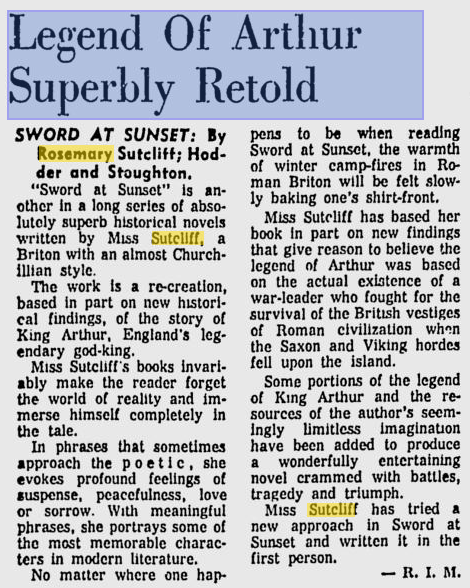
For award-winning, internationally-acclaimed author Rosemary Sutcliff (1920-92). By Anthony Lawton: godson, cousin & literary executor. Rosemary Sutcliff wrote historical fiction, children's literature and books, films, TV & radio, including The Eagle of the Ninth, Sword at Sunset, Song for a Dark Queen, The Mark of the Horse Lord, The Silver Branch, The Lantern Bearers, Dawn Wind, Blue Remembered Hills.
Rosemary Sutcliff‘s books are loved by Hayao Miyazaki, who is one of Japan’s foremost living fantasy film-makers. In the 1980s and 90s his animations were huge hits at the Japanese box-office. Princess Mononoke was the biggest-earning Japanese film ever. Miyazaki is on record as a fan of the historical novels of Rosemary Sutcliff. Miyazaki’s films have been noted for their strong, self-reliant heroines, so I dream of him adapting Song for a Dark Queen!
I am trying to make accurate my list of all book awards Rosemary Sutcliff was given or nominated for. This is my summary so far: can readers help me expand and improve it?
1959: The Carnegie Medal, The Lantern Bearers
1968: The Hans Christian Andersen Award, nominated
1971: Zilveren Griffel – The Silver Pencil, in Holland
1972: The Boston Globe-Horn Book Award, Tristan and Iseult
1974: The Hans Christian Andersen Award, highly commended
1978: The Other Award, Song for a Dark Queen (A children’s book award focusing on anti-sexist, anti-racist titles in the UK).
1985: The Phoenix Award, The Mark of the Horse Lord
Rosemary Sutcliff – historical novelist and children’s book writer – is the object of an essay by John Rowe Townsend in his 1971 book A Sense of Story —as blog reader and commenter Anne highlights at another post. She notes that his observation that Rosemary Sutcliff’s books amount to “a body of work rather than a shelf of novels” is is taken from what she refers to as the essay’s “wonderfully striking and poetic introduction”:
Day to day, minute to minute, second to second the surface of our lives is in a perpetual ripple of change. Below the immediate surface are slower, deeper currents, and below these again are profound mysterious movements beyond the scale of the individual life-span. And far down on the sea-bed are the oldest, most lasting things, whose changes our imagination can hardly grasp at all. The strength of Rosemary Sutcliff’s main work—and it is a body of work rather than a shelf of novels—is its sense of movement on all these scales. Bright the surface may be, and vigorous the action of the moment, but it is never detached from the forces underneath that give it meaning. She puts more into the reader’s consciousness than he is immediately aware of.
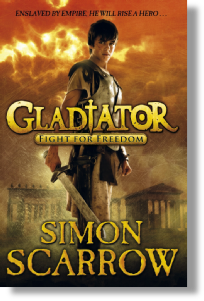
Author Simon Scarrow dedicates to Rosemary Sutcliff his new young adult book Gladiator: Fight for Freedom. I am alerted to this by reader and commenter on this blog ‘JB’ (5 Feb on post here). Thank you JB , for I was unaware of the dedication – or the book – and am off to get it.
For Rosemary Sutcliffe (sic) who has inspired so many of us to love history.
Oh Dear Sutcliff spelt wrongly again, with an E. In fact JB writes:
… (it) has an interesting plot and a dedication to Rosemary Sutcliffe (sic). Mr Scarrow speaks highly of Miss Sutcliff and whilst I do not blame him for the typo, I do wonder who does his proof reading. It would be the work of a moment to check the spelling of Miss Sutcliff’s surname.