Rosemary Sutcliff shows ‘total imaginative penetration of historical material’

The root of the matter is no secret, yet it defies exact interpretation beyond saying that the vital spark of Rosemary Sutcliff’s books, from The Eagle of the Ninth onwards, is the total imaginative penetration of the historical material. The books seem to be written from the inside, so that the reader’s identification with the chief character carries him further into the felt life of the time than many other books which are made up of the skilful but detached articulation of the fruits of research. One feels that Rosemary Sutcliff is less concerned to write historical narrative than to reconstruct, in the child’s response to her creative imagination, a strong feeling for and involvement with the people of this mist-bound, huddling, winter-dark island at the periods when the invaders came, Romans, Saxons, Norsemen.

Source: Margaret Meek (1962) Rosemary Sutcliff. New York, N.Y.: Henry Z. Walck .

Wood-shore or woodshore or ‘wood shore’ | A Rosemary Sutcliff phrase?

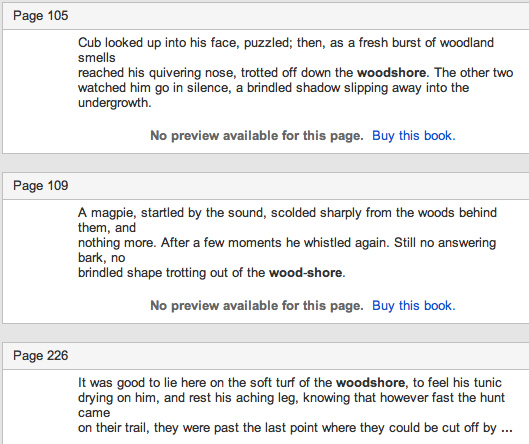
A blog entry elsewhere reminded me of one of the many evocative phrases Rosemary Sutcliff used in her work: ‘wood-shore’. I thought, like Tom Bradman, that it was in Warrior Scarlet. But in fact it appears (?also) in the Lantern Bearers (“Take him out to the wood-shore and bind him to a tree”) and searching Google immediately reveals it, presented as ‘woodshore’, in several places in the paperback OUP edition of The Eagle of the Ninth .

I kissed a girl at Clusium | From The Eagle of the Ninth by Rosemary Sutcliff

All of which set me thinking about poems and songs in Rosemary Sutcliff’s novels. Such as the snatches of a legionnaires’ song in The Eagle of the Ninth.

Oh when I joined the Eagles
(As it might be yesterday)
I kissed a girl at Clusium
Before I marched away
A long march, a long march
And twenty years in store
When I left my girl at Clusium
Beside the threshing-floor

The girls of Spain were honey-sweet,
And the golden girls of Gaul:
And the Thracian maids were soft as birds
To hold the heart in thrall.
But the girl I kissed at Clusium
Kissed and left at Clusium,
The girl I kissed at Clusium
I remember best of all

Michael Rosen investigates discussing feelings now in the classroom | Teacher used Rosemary Sutcliff in 1970s

Michael RosenOne of the best-known figures in the children’s book world, the excellent Michael Rosen has a “serious question” to ask at his blog this week about “classroom discussion”:

How many hours a week is it possible to have a discussion with a class or within a class where ideas are discussed – not as a debate with ‘sides’ but simply discussing ideas? And parallel with that: how many hours or minutes a week is it possible to talk about feelings? Or both at the same time? This kind of discussion might arise out of a book, a poem, a song, a piece of art – or just stimulated by something that has happened or that someone has seen. Or indeed from eg Philosophy lesson or Circle Time.

Answers please on a postcard – no – on facebook or twitter please. Just curious to know how much room there is for this sort of thing now. Any Key Stage.
Source: Michael Rosen.

… and I would add, I am interested in anyone using Rosemary Sutcliff‘s work or life to prompt such discussion in classrooms. I recently posted a quote from Margaret Meek in Books for Keeps which points to just the sort of discussion I take Michael Rosen to value. But that was many years ago.

… I remember, with gratitude and some pain, a class of girls in a London secondary school in the early seventies. The parents of most of them had come from the Caribbean; I guess their own children are now in school. Then they were the first of their kind to speak out their awareness of the complications we now call `multi-cultural’. They were reading with their gifted teacher, Joan Goody, The Eagle of the Ninth (by Rosemary Sutcliff). On this particular day they ignored the dashing young Roman hero, recovering from a battle wound in his uncle’s house in Bath, and concentrated on the girl next door, Cottia, a Briton. Cottia’s uncle and aunt were taking her to the games, and in their hankering after Roman ways had tried to insist that she wear Roman clothes and speak Latin. Cottia protested, and so did the readers, on her behalf. I’ve never heard a more spirited discussion than that one, when those girls spoke indirectly of their nearest concerns in arguing on behalf of Cottia, who existed only in a book.
Source: Article by Margaret Meek | Books for Keeps Issue 64


Nuns, monks and friars in the historical fiction and children’s books of Rosemary Sutcliff

Stimulated by an article in The Guardian which recalled Rahere in The Witch’s Brat, I am trying to track down all the nuns, monks and friars in the historical novels and children’s books by Rosemary Sutcliff. Commenters at the Facebook page on Rosemary Sutcliff associated with this blog are helping … can you (if you have not already!)?

Monks, friars and nuns in Rosemary Sutcliff's books