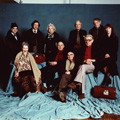
Rosemary Sutliff’s prose was “always characterised by compassion”.

The Independent (London) —August 20, 1992—published some comments on their obituary of Rosemary Sutcliff, which noted that she had “a feeling for the mending side of life”.

Last year I interviewed Rosemary Sutcliff on the Arthurian theme in her fiction.

The published text arrived a matter of days before her death and on rereading the transcript I was reminded of her vitality and enthusiasm, of an honest approach which combined scholarship with an unsentimental attitude to pain and suffering.

As Julia Eccleshare observed of her writing (of the obituary), allusions to historical sources are present but never signposted, the battle narrative magnificent yet never glorifying the strife it depicts. These traits were most apparent perhaps in her adult novel Sword at Sunset, the ‘autobiography’ of King Arthur, and the work of which she was most proud. But as Sutcliff herself acknowledged, she also had ‘a feeling for the mending side of life’ and whether writing of the physically and emotionally crippled, or, when following in the footsteps of her beloved Kipling, of the healing which happens when clashing cultures learn to live together, her prose was always characterised by compassion.

She felt that as the years progressed she had become a tougher writer, a belief reinforced by a reading of The Shining Company, itself based upon the poem Y Gododdin, which celebrates the annihilation of an army at Catterick in cAD600. (Sacrifice was always a theme which fascinated her).

Yet for all her seriousness, she remained a cheerful and remarkably modest author, seemingly surprised by her success.’You’re always terrified that the books you write are going to go downhill,’ she once said. It seems unlikely that those books which remain to be published will disappoint.

‘That’s not a sand-castle,’ said the busy child on the beach, ‘I’m building a temple to Mithras.’ | After reading Rosemary Sutcliff

Cover of Books for Keeps, March 2010

Brian Alderson founded the Children’s Books History Society; he was once Children’s Books Editor for The Times newspaper. Writing in Books for Keeps in 2010, he  recalled an anecdote once told to librarians by Rosemary Sutcliff in the 1950s: ‘That’s not a sand-castle,’ said the busy child on the beach, ‘I’m building a temple to Mithras.’

In all probability the temple-builder’s enthusiasm for the work came from hearing its famed serialisation on ‘Children’s Hour’ but (perhaps unlike television serials) the wireless version sent listeners straight back to the book to get the author’s full-dress narrative to go with the spoken one.

They were keen readers, those librarians – our first critics, long before the academic brigades were mustered – and for them, at that time, the landing of The Eagle of the Ninth had something of the force of a revelation. True, it did not come from an entirely unknown author.Read More »

Did Rosemary Sutcliff have a disability or a handicap?

When Rosemary Sutcliff contracted Still’s Disease —severe juvenile arthritis, which left her mobility severely affected all her life—in the 1920s, the terms  ‘disability’ & ‘handicap’ were used equally. Now 90% of the use is  ‘disability’.

Relative use of terms disability and handicap


When she was first ill, she was most likey to be said to be handicapped. By the time of her death she was more likely to be said to be disabled; and were she alive now, increasingly she would be said to have a disability.

Comparing being disabled, crippled and handicapped

Rosemary Sutcliff, disabled by juvenile arthritis, was thankful to go to inclusive school, not ‘incarcerated with other disabled children’

Rosemary Sutcliff was very ill as a child with juvenile arthritis. She spent much of her time when very young in hospital or a spinal carriage ‘rather like a coffin’, only went to school aged nine, and was disabled from the disease all her life.

A spinal carriage was rather like a coffin; it was very uncomfortable, and you lay flat out in this thing, and of course all you could see were the branches of the trees or the roofs of the houses going by overhead. And it was extremely boring. With any luck you were perhaps allowed to sit up on the way home from a walk.

Spinal carriage similar to Rosemary Sutcliff's

I didn’t go to school for a very long time …My mother used to educate me herself, chiefly by just reading to me the books that she liked. But I did go to school, and I’ve always been very thankful that I went to an ordinary school, I never got incarcerated with other disabled children.

Read More »

Portraits of Rosemary Sutcliff at The National Portrait Gallery

Portrait of Rosemary Sutcliff by Mark Gerson

I have just discovered, courtesy of Bing search and never found on Google,  two portraits of Rosemary Sutcliff which I had not seen for many a year. They are  at The National Portrait Gallery. I have applied for full size reproduction rights. Meanwhile two thumbnails must suffice. The one below is by Lord Snowden, for the Sunday Times who I think had compiled a list of top twenty authors of the 20th Century

Rosemary Sutcliff in a poprtrait at The National Portrait Gallery

The others in the photo are:

  • Dame Beryl Bainbridge (1932-2010), Novelist and actress.
  • Sir John Betjeman (1906-1984), Poet Laureate, writer and broadcaster.
  • Sir Malcolm Stanley Bradbury (1932-2000), Novelist and critic.
  • Anthony Burgess (John Burgess Wilson) (1917-1993), Novelist and critic; composer.
  • Leon Garfield (1921-1996), Writer.
  • Laurence Edward Alan (‘Laurie’) Lee (1914-1997), Poet and prose writer.
  • Rosamond Nina Lehmann (1901-1990), Novelist.
  • Sir Victor Sawdon (‘V.S.’) Pritchett (1900-1997), Writer and critic.
  • Sir Laurens Jans van der Post (1906-1996), Writer, farmer, explorer and conservationist.

Source: National Portrait Gallery