Rosemary Sutcliff followed in Geoffrey Trease’s writing footsteps in the 1950s, but not his political footprints

That Rosemary Sutcliff followed in the footsteps of children’s writer Geoffrey Trease was the accurate claim of an intriguing article a couple of years ago in The Morning Star (the link I had does not now work, but I have found the article— below —on Wayback Machine). I was moved to write to the editor:

Although you carry a fascinating article yesterday (February 25, 2010) by Farah Mendlesohn about Geoffrey Trease, may I correct a couple of errors of fact? If Rosemary Sutcliff (sic) did indeed “follow” in “Trease’s footsteps”, she started following in the 1950s not the 1960s as stated, with her award-winning Lantern Bearers and The Eagle of the Ninth which were both published in that earlier decade.

Furthermore, in all decades her name was spelled without the ‘E’ … As to the detail about Trease, whilst not a matter of fact, I think it interesting that in one respect Rosemary Sutcliff certainly did not follow in his footsteps. I grew up listening to her, as a close relative. I heard how much she treasured Trease’s work, but I do not think that she shared the political leanings that the article explores.

The man who told the people’s stories

A mystical communion with the past … and one of the rudest senses of humour in anyone I have met! |An editor on Rosemary Sutcliff

I once found that an editor of Rosemary Sutcliff once wrote (I could not for a long time locate the source, a website on ancient history, but see Anne’s comment below):

 I knew Rosemary as a friend and, briefly, as her editor…most of her best writing was done in the 50s and 60s, beginning with The Eagle of the Ninth and ending with The Mark of the Horse Lord, which is my own favourite. What she really wanted to do, however, was to write romantic novels full of sex, but here her experience, and imagination, let her down. She was crippled by Still’s disease, contracted as a child – many of her protagonists have physical disabilities of one kind or another. She had no movement in her legs, and hands whose work (including writing and miniature painting) was done with just a forefinger and a tiny, rudimentary thumb.

She had, as did Henry Treece, a mystical communion with the past, which enabled her both to recreate tiny details, and to confound military historians with her understanding of the art of battle in any situation she cared to devise. Her sense of place was uncanny, in that she could get no nearer to a site than the seat of a car on an adjacent road. Friends often served as her eyes, and also as her researchers, but it was the conclusions she drew from the evidence, and her re-creations of them, that made her contribution to the literature about the ancient world so distinctive. Where she was simply embellishing recorded history, she was no better than anyone else.

She also had one of the rudest senses of humour in anyone I have met.”

The Witch’s Brat by Rosemary Sutcliff | One of 10 must-read children’s books | Telegraph

To mark World Book Day 2014 yesterday, Richard Davies of AbeBooks.co.uk chose ten ‘must-read’ children’s classics that can be bought secondhand for less than £1 each. One was The Witch’s Brat by Rosemary Sutcliff.

Famous for her historical fiction and retelling or myths and legends, Sutcliff transports readers to 12th century England in The Witch’s Brat, the tale of Lovel the outcast.

Lovel, the crippled hero of Rosemary Sutcliff‘s The Witch’s Brat, is driven from his village in a shower of stones after his grandmother’s death. (The) novel (is) … crammed with careful period detail and research, the painstaking catalogues of herb-lore brought grippingly to life by the characters to whom they bring such danger.

Writing for The Guardian in 2011 Imogen Russell Williams explored the enchantments of witch fiction. Of The Witch’s Brat  she wrote:

 … Lovel, the crippled hero of Rosemary Sutcliff’s The Witch’s Brat, is driven from his village in a shower of stones after his grandmother’s death.  Both novels are crammed with careful period detail and research, the painstaking catalogues of herb-lore brought grippingly to life by the characters to whom they bring such danger.

The other titles in the top ten were: Read More »

Dawn Wind (by historical novelist and children’s writer Rosemary Sutcliff) |Reprint reviewed in Historical Novels Review

Over at Twitter I am tracking down people who can say #Ireadsutcliff , and their favourite(s). Merrian Weymouth in Australia favours —possibly— Dawn Wind, which was recently reprinted. The Historical Novel Society had this to say of it:

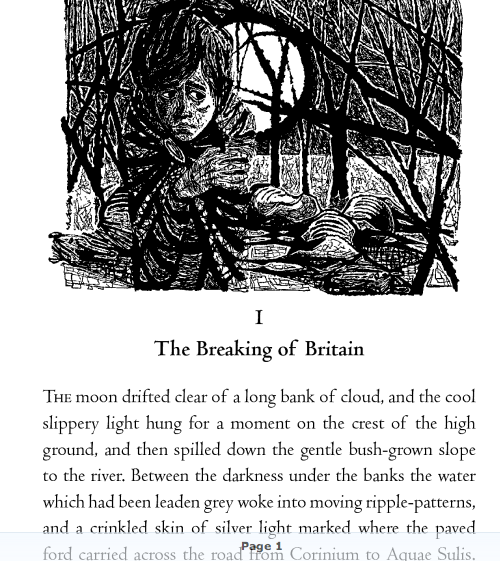
First published in 1961, this reprint keeps its original charm by reproducing the black and white illustrations by Charles Keeping. Dawn Wind represents historical fiction at its best. It was written by an author who delighted readers with her detailed and atmospheric stories. It is equally suitable for both young adult and adult readers. A thoroughly enjoyable book.

The novel starts:

The first paragraph of Rosemary Sutcliff’s Dawn Wind