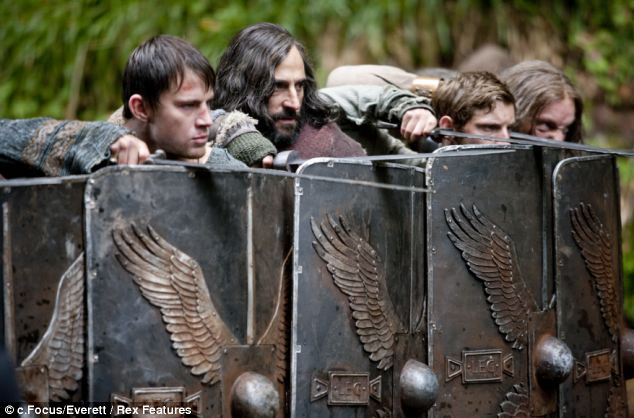
‘It would seem that Sutcliff was right after all” | The Eagle and The Eagle of the Ninth | More on The Roman Ninth Legion’s mysterious loss | BBC News

Ninth Legion stampRosemary Sutcliff‘s The Eagle of the Ninth is grounded in a view about what happened to the ninth Roman legion. The fate of the legion continues to be debated, most recently on the BBC website, by Miles Russell of Bournemouth University.

The British problem was of deep concern to Roman central government. Thanks to a tombstone recovered from Ferentinum in Italy, we know that emergency reinforcements of over 3,000 men were rushed to the island on “the British Expedition”, early in Hadrian’s reign. The emperor himself visited the island in AD 122, in order to “correct many faults”, bringing with him a new legion, the Sixth.

The fact that they took up residence in the legionary fortress of York suggests that the “great losses” of personnel, alluded to by Fronto, had occurred within the ranks of the Ninth.

Archaeological evidence of the legion’s fate is scarce

It would seem that Sutcliff was right after all.

It was the Ninth, the most exposed and northerly of all legions in Britain, that had borne the brunt of the uprising, ending their days fighting insurgents in the turmoil of early 2nd Century Britain.

Source: BC News – The Roman Ninth Legion’s mysterious loss.

See also on this blog a post on The symbolism of The Eagle of the Ninth | What happened to the ninth legion: Part IX?
The symbolism of The Eagle of the Ninth | What happened to the ninth legion: Part IX?
Last week I met Professor Michael Fulford of Reading University archaeology department, who introduced me (and a crowd of film journalists covering The Eagle film) to some Roman history at Silchester – Calleva in Rosemary Sutcliff‘s The Eagle of the Ninth historical novel for children (of all ages!). I asked him for his take on the fate of the ninth legion, and he has written to me (with permission to reproduce his words – thank you Michael):

At the time Rosemary Sutcliff wrote The Eagle of the Ninth it was the general view that legio IX Hispana, based at York (Eburacum) had somehow come to grief in northern Britain.  There was no specific evidence for a disastrous battle but the record of the legion stopped with an inscription of AD 107-8, commemorating the construction of a building by the legion within the fortress at York.

Since the 1950s further evidence of the fate of the legion has come to light.  There is a tile and a mortarium (specialist pottery vessel) from the legionary fortress at Nijmegen in the Netherlands, each stamped by the legion (LEG VIIII; LEG VIIII HIS), which date to the early 2nd century.  There are also inscriptions of NCOs and officers of the legion whose career profiles are such that the legion must have still been in existence in the 120s, ie after work started on the construction of Hadrian’s Wall in Britain.  Although there can be no certainty about this until more evidence emerges, it is likely that, after a period in lower Germany (at Nijmegen), the legion was transferred to the East.  If it was not destroyed in the war against the Jews later in Hadrian’s reign, it might have met its fate in the war against Parthia in the early 160s.  The historian Cassius Dio mentions an unnamed legion which was destroyed at the siege of Elegeia in Armenia in 161.

Even if we can no longer associate the loss of the Ninth with Britain, the story, The Eagle of the Ninth can be seen to be symbolic of the fairly constant struggle between Rome and the tribes of northern Britain, from the time of the 1st century governors like Petilius Cerealis and Agricola onwards, through the construction of Hadrian’s Wall, the later building of the Antonine Wall between Clyde and Forth, the return to the previous frontier line, and so on.

“As The Eagle film dramatises ancient tale, the 2,000 year riddle of Rome’s lost Ninth Legion is solved” | Mail Online

Rosemary Sutcliff‘s imagined fate of the ninth legion, as told in her historical novel for young adults The Eagle of the Ninth, which is the basis for the new film The Eagle, is about to receive support from a new documentary by UK producer-director Phil Hirst. According to the UK Daily Mail:

For centuries, historians have puzzled over the disappearance of a legion of 5,000 battle-hardened Roman soldiers in northern Britain around 108 AD.The ancient riddle, which has captivated storytellers, has just been dramatised by Hollywood in The Eagle, starring Channing Tatum and Jamie Bell. Now, experts have revealed that the children’s book on which the film is based is more fact than fiction …

The dramatic new evidence hinges on a single gravestone tribute and was brought to light by historian and film-maker Phil Hirst, whose documentary Rome’s Lost Legion will be screened next month.

I know this is going to be controversial, not least from various conversations and comments on this blog! But it is good publicity for Phil Hirst’s documentary, the film The Eagle, and let us hope also, the book The Eagle of the Ninth. (The documentary Rome’s Lost Legion is on the History Channel on March 18. The Eagle opens in UK cinemas on March 25. The book has been available since 1954 …)

Source: As a Hollywood film dramatises ancient tale, the 2,000 year riddle of Rome’s lost Ninth Legion is solved at last | Mail Online.

Rosemary Sutcliff and Elzabeth Goudge | English Civil War Novels

Children’s writer and historical novelist Rosemary Sutcliff and Elizabeth Goudge were linked, ‘Anne’ comments in response to an earlier post:

Interestingly, Sutcliff and Goudge corresponded with each other, and Goudge wrote publicity comments to go with both Sword at Sunset and Rider on a White Horse.

To me Rider of the White Horse goes hand-in-hand with Elizabeth Goudge’s ‘White Witch’, another novel of the English Civil War which is also magically evocative. Read More »

Rosemary Sutcliff novels and the North-East of England

Rosemary Sutcliff’s novels and children’s books were  highlighted by Alan Myers who compiled an A to Z of the many writers who had a significant connection with the North-East of England. By 2008 (when I first posted this) I thought it had disappeared from the web but no, it is here.

One of the most distinguished children’s writers of our times, (some of ) Rosemary Sutcliff’s  …  books … (are now) considered classics. She sets several of her best-known works in Roman and Dark Age Britain, giving her the opportunity to write about divided loyalties, a recurring theme. The Capricorn Bracelet comprises six linked short stories spanning the years AD 61 to AD 383, and Hadrian’s Wall features in the narrative.The Eagle of the Ninth (1954) is perhaps her finest work and exemplifies the psychological dilemmas that Rosemary Sutcliff brought to her novels. Read More »