In Praise of Rosemary Sutcliff, historical novelist and writer for children| An editorial in The Guardian newspaper

From the cover of Rosemary Sutcliff's autobiography The Blue Remembered Hills

Rosemary Sutcliff‘s 1954 children’s classic The Eagle of the Ninth (still in print more than 50 years on) is the first of a series of novels in which Sutcliff, who died in 1992, explored the cultural borderlands between the Roman and the British worlds – “a place where two worlds met without mingling” as she describes the British town to which Marcus, the novel’s central character, is posted.

Marcus is a typical Sutcliff hero, a dutiful Roman who is increasingly drawn to the British world of “other scents and sights and sounds; pale and changeful northern skies and the green plover calling”. This existential cultural conflict gets even stronger in later books like The Lantern Bearers and Dawn Wind, set after the fall of Rome, and has modern resonance. But Sutcliff was not just a one-trick writer.

The range of her novels spans from the Bronze Age and Norman England to the Napoleonic wars. Two of her best, The Rider of the White Horse and Simon, are set in the 17th century and are marked by Sutcliff’s unusually sympathetic (for English historical novelists of her era) treatment of Cromwell and the parliamentary cause. Sutcliff’s finest books find liberal-minded members of elites wrestling with uncomfortable epochal changes. From Marcus Aquila to Simon Carey, one senses, they might even have been Guardian readers.

Michael Rosen commented on this editorial:

Interesting that she was writing about the end of an empire at the end of…er…an empire. And does the search for the lost legion echo/refract Conrad’s Heart of Darkness?

Some of us drank in The Eagle of the Ninth two ways: once as a BBC Children’s Hour serial and second time as the book. I can remember hurrying to get home to hear it – moody, dangerous, mysterious – a quest for something real but long gone, a possible solution to an unsolved story…and somehow it had something to do with events that happened a long time ago just where you walked when we were on holiday: on moors, or on wet fields where we were camping. The book made a connection for me between a past and that particular present.

Rosemary Sutcliff, eminent author of children’s literature, prided herself on not writing down for children

The Oxford Encyclopedia of Children’s Literature has an entry on historical novelist and writer of literature for children, Rosemary Sutcliff. It comments on her use of language:
Critics of Sutcliff’s work sometimes comment on its difficulty both in terms of the language she employs and in terms of the historical depth her novels embrace. But for Sutcliff herself, these sorts of evaluations of her writing were welcomed as compliments. She prided herself on never writing down to her readers, expecting them instead to be enticed into enjoying a compelling and demanding tale by the pageantry of history and the warm humanity of people in every era. She carefully creates dialogue in her novels that recollects the speech of a bygone era without falling into what she termed “gadzookery.”
  • Source: The Oxford Encyclopedia of Children’s Literature. Ed. Jack Zipes. Oxford University Press, 2006.

Rosemary Sutcliff, historical novelist and writer for children, had a profound sense of the British landscape and its past | Philip Reeve

In the summer of 2009, The Daily Telegraph newspaper asked children’s writers and critics what books they would recommend for holiday reading. Acclaimed author Philip Reeve urged what he called classics, by Rosemary Sutcliff.

Philip Reeve recommended Rosemary Sutcliff reading


Source: The Daily Telegraph, 3 July 2009

Sunday Times writer Sally Hawkins chooses Rosemary Sutcliff historical novel The Eagle of the Ninth as the book that changed her life

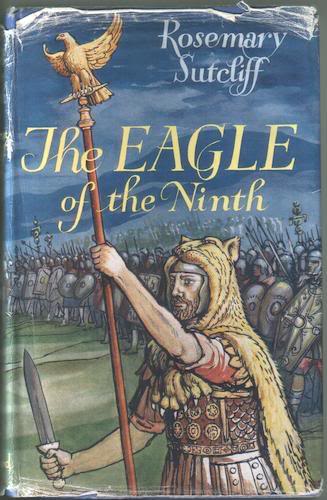
The Eagle of the Ninth, original book jacket OUP

Sally Hawkins, who writes for the Sunday Times, was asked to choose a ‘special book’ that changed her life, and explain why it means so much to her.

When I was eight, my taste suddenly moved on from What Katy Did at School and Swallows and Amazons to history. History with boys in it. The Eagle of the Ninth wasn’t the first historical novel I read, but it is one I found myself caught up in all over again, when the film version appeared in 2011. Fifty years on, I found its you-were-there depiction of Roman Britain and gripping plot as beguiling as ever.

I now realise I can trace my academic choices back to this tale of a young man searching for a lost legion — and missing father. Rosemary Sutcliff based it on authentic sources, and this intrigued me. The novel fired my interest in history; it was lurking behind my teenage passion for the First World War poets; and, from there, it was just a short step to my signing up for postgraduate degrees in medieval literature.

Re-reading Sutcliff, I realise just how un-condescending to younger readers her style and vocabulary are: what they don’t understand will just have to be looked up in a dictionary or on the internet. But the story is so compellingly told, they won’t be put off. More important, the book taught the younger me about friendship, courage and integrity. Sutcliff’s heroes are models of how to be good people, but never priggish or unbelievable. I bet George R R Martin read this book before embarking on his Game of Thrones series. The Wall for him is as potent a symbol of the divide between civilisation and darkness as it is for Sutcliff’s young Roman officer.

One source of inspiration for David Mitchell’s The Bone Clocks: Rosemary Sutcliff’s The Lantern Bearers

Cover of The Bone Clocks by David Mitchell
David Mitchell’s The Bone Clocks was nominated for the 2014 Man Booker Prize. Holly Sykes, the heroine, appears in some form in each of its six segments, which begin in 1984 and stretch to 2034. The sixth and final portion imagines a near future in which an ‘Endarkment’ has reset the world into barbaric times.

In an interview for an online magazine about books, arts, and culture—The Millions— David Mitchell was asked whether any specific sources inspired his vision of how the world might look in twenty years time. He spoke first of a “really good book published in the 1950s called The Death of Grass where a killer virus doesn’t kill us, humans…but gets the crops we eat”. The second source of inspiration was Rosemary Sutcliff’s The Eagle of the Ninth series, which is “the book that Holly is reading to the kids in the last section”.

Cover of The Lantern Bearers


Cover of The Death of Grass


Rosemary Sutcliff … was an English, wheelchair-bound classicist in the 1950s who wrote about the Romans leaving Britain and the collapse of Roman civilization. The series focuses on the power vacuums a collapse of that magnitude leaves, and how the innocents always end up having to pay more then the soldiers. Those books are colossal. They are fantastic. In the third book of the trilogy, The Lantern Bearers, the best of the three, there is a scene where the Roman ships leave the shores of Britain for the last time, and they know it’s the last time. What are they leaving behind? What’s going to happen to these people? That’s what was at the forefront of my mind—really how our world will look to my daughter as she grows—as I was writing that last section.