
This time around I’m giving away a copy of the YA novel, Flame-Coloured Tafetta, by Rosemary Sutcliff. This is the book that sent me on the hunt for more titles by Sutcliff and led to what is currently still my favorite book that I’ve read this year: The Eagle of the Ninth. Don’t you love it when you stumble across wonderful new authors you never knew existed? Here’s the blurb from the book jacket (this is a hardcover book):
When twelve-year-old Damaris discovers a young man who has been shot in the woods near her house, she doesn’t stop to worry that he may be a smuggler or spy wanted by King George’s Custom House men. Instead she turns to those she can trust–her best friend, Peter, and Genty Small the Wise Woman–for help in saving his life. And after Tom Wildgoose recovers enough to be able to talk about himself, but chooses to be evasive when answering Damaris’s questions, she doesn’t really mind. What is important to Damaris is that he will be leaving soon, taking away all the adventure and mystery he had suddenly brought into her life.
But then Tom is captured by Mr. Farrington, who threatens to turn him over to the authorities. In a true act of loyalty, Damaris jeopardizes her own safety to rescue the mysterious young man and set him free once again.
If this sounds like a book you’d like to win, then leave me a comment telling me the name of a favorite new author you’ve read in the last 12 months. INCLUDE YOUR EMAIL ADDRESS SO I CAN CONTACT YOU IF YOU WIN.
Category: Novels, Stories & Books
Rosemary Sutcliff was an internationally renowned writer of historical novels, for children, young adults and adults. She also wrote stories for children. This category compiles the posts on this blog by title.
US School guides summer reading of Rosemary Sutcliff’s The Eagle of the Ninth
I found that a US School – St Sebastian’s in Needham, MA – was encouraging summer reading of Rosemary Sutcliff’s children’s historical novel The Eagle of the Ninth. I was delighted of course, but wondered if the questions would encourage an emotional and reflective, as well as descriptive, reaction to the novel. Am I being churlish?
History 8 – Summer Reading Guide
The Eagle of The Ninth by Rosemary Sutcliff Where does this historical novel take place?
What are the modern day countries that the story takes place in?
In your atlas find each of the places mentioned in the List of Place-Names at the back of the book.
How does these locations relate to the Roman Empire?
Who are the characters in this novel?
How do they fit in to the Roman Empire?
What are some differences between the Roman occupiers and the native residents of the north and the south?
If you have seen the movie, what differences are there from the book?
Another Pile of Books includes Rosemary Sutcliff | Song for a Dark Queen
First, chronologically speaking, in my big pile of Roman-setting (Rosemary) Sutcliffs : the tragic, doomed story of Boudicca (Song for A Dark Queen). I’d read this before several times, but I re-read it recently. It’s very dark, especially for a children’s book – she doesn’t pull her punches, everything in Cassius Dio’s not-really-very-contemporary-but-best-we’ve-got account is there: the rapes, the casual violence of the Romans, the torture and sacrifice of Roman women by Boudicca’s forces.
Boudicca is horrifying in this, but the writing is fabulous, and for me, it really works. Even though Boudicca ends up doing horrifying things, I felt that I ended up caring for the character and feeling a sort of understanding for her.
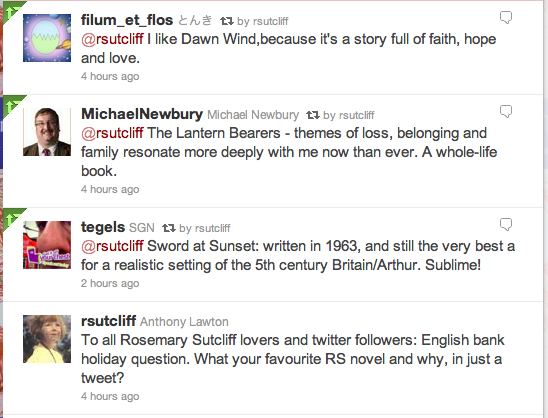
Twitter users report favourite Rosemary Sutcliff books | Dawn Wind, The Lantern Bearers, Sword at Sunset
Is Rosemary Sutcliff’s Beric a Briton?
Is Beric a Briton?: the Representation of Cultural Identity in G.A. Henty’s Beric the Briton (1893) and Rosemary Sutcliff’s The Outcast (1955) is an academic article by Rachel Johnson from 2009. (In: Past Continuous: Historical Fiction for Children, Newcastle University. , October 2009, Newcastle University). There is a copy of the article here. The Abstract summarises the thesis:
This article is an investigation into differences in the representation of cultural identity represented in Beric the Britain by G.A. Henty (1893) and The Outcast by Rosemary Sutcliff (1955). G.A. Henty (1824-1902) and Rosemary Sutcliff (1920-1992) both present narratives of Britain under Roman invasion through the character of a young protagonist, initially perceived in both narratives as the product of a British tribal chieftain’s family with a clear cultural identity. Henty wrote in the second half of the nineteenth century at the height of imperial expansion when the sense of English cultural identity was strong. In contrast, Rosemary Sutcliff, writing post-empire, represents a more complex sense of identity. I investigate the mixed cultural identity of Sutcliff’s protagonist against the foundation of the exclusively British cultural identity of Henty’s Beric, thus foregrounding the increasing destabilization of cultural identity demonstrated in these two texts.
 ROSEMARY SUTCLIFF (1920-92)