… Everything in the garden bursting while you look at it …

Source: Rosemary Sutcliff’s personal diary, March 1992

Rosemary Sutcliff said to the Radio Times in 1977: “I like a child or a dog or an adult according to their merits. I am prone to like more dogs on a percentage basis”! Dogs also feature in many of her books. Katherine Langrish, fantasy novelist, wondered if “perhaps Rosemary wrote about dogs as a way of owning […]
… Everything in the garden bursting while you look at it …
Source: Rosemary Sutcliff’s personal diary, March 1992
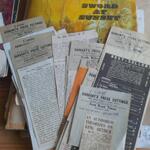
 Christina Hardyment’s life of Thomas Malory was published by HarperCollins. In 2012 she reviewed a 50th anniversary re-publication of Rosemary Sutcliff’s bestseller Sword at Sunset—an Arthurian era novel—which was, in 1963 when it was first published, “firmly announced to be for adults, and given the (for their time) graphic and violent scenes of sex and slaughter, it deserved to be.”
Rosemary Sutcliff is most famed for The Eagle of the Ninth, but there was much more to her than that. In the 1950s, historically-minded children found her books a magic carpet into the past. I began with Brother Dustyfeet (1952) and The Armourer’s House (1951), and never looked back an insatiable interest in history has remained the backbone of my life.
Sword at Sunset is, unusually for Rosemary Sutcliff, is a story told in the first person. Artos becomes the High King of Britain but his fate has been written ever since he was drugged and seduced by his half-sister Ygerna. Their child Medraut becomes a boy filled with hate by his mother.
…(Sutcliff) drew as much upon the archaeology of Celtic and Saxon Britain as on the ancient legends in Malory’s Morte D’Arthur and Guest’s Mabinogion. She also admired T. H. White’s four idiosyncratic Arthurian novels (now known as The Once and Future King), and the intensity with which she inhabits the mind of her hero Artos has echoes of White’s extraordinary characterisation of Arthur. ‘I have never written a book that was so possessive,’ Sutcliff said in an interview in 1986. ‘It was almost like having the story fed through me’. Writing as a man possessed her; afterwards, ‘I had great difficulty getting back into a woman’s skin.’
Her narrative amazes in the sheer vigour of its visualisation and its sure sense of purpose. Lanterns, sunsets, fires, the aurora borealis and other manifestations of light recur: Artos is holding back the coming of the dark long enough for there to be hope that the civilised light that was Rome will survive to be adopted by its conquerors. Battles are heart-stopping, tense and unpredictable, winter weather effects are frostbite-inducing, and Artos’s travels across Britain are confidently mapped …
No-one would dream from reading Sword at Sunset and Sutcliff’s other action-packed, fast-moving tales of Roman and Celtic warriors that she remained severely crippled all her life with the juvenile arthritis she contracted as a very small child. Once one is aware of this, a recurring theme of incapacitating wounds is better understood; as is the important role she gives to the hounds and horses in which she found such consolation.
For reasons I cannot divine, my Google alert for new items on <Rosmeary Sutcliff> pointed today to a 2011posting at this blog about her appearance on BBC Radio’s Desert Island Discs! At that time, a recording of Rosemary Sutcliff’s appearance with Roy Plomley was not available for downloading. It is now, here.
In the usual way on this radio programme, Rosemary Sutcliff talked (in October 1983) about her life and work and chose eight records to take to the mythical BBC Radio desert island. She said she chose her music just because she loved it—not everyone does, especially these PR-obsessed days. Her choices were:
Read more about Desert Island Discs, and stream the episode, here
 ROSEMARY SUTCLIFF (1920-92)