The Captive Reader finally finishes reading Blue Remembered Hills by Rosemary Sutcliff

After “dragging it out as long as (she) could  Claire (The Captive Reader)  has blogged that she has “finally finished reading Blue Remembered Hills by Rosemary Sutcliff”.  She writes that “Sutcliff’s memoir of her childhood and early adulthood is delightfully-written but cruelly slim.  I rationed myself, reading only little bits at a time, trying to savour the treat as long as possible”. She goes on:

The danger of childhood memoirs is always that they might descend into that treacly swamp of sentimentality that can only leave the reader feeling queasy and the author, one hopes, embarrassed.  This is decidedly not one of those memoirs.  Sutcliff is affectionate in her remembrances but never boringly nostalgic for days gone by or pitying for the circumstances she faced.  She has a marvellous sense of humour and wonderful eye for detailing, making the reader feel part of the episodes she shares with us.

It was a delight to be reminded of specific passages, such as this one about Rosemary not learning to read and not wanting to (Rosemary Sutcliff could not read until she was about ten):

…I still had my inability to read.  My father now joined the battle, and had small serious talks with me.

‘When you can read to yourself, old girl, you will find a whole new world opening up to you.’

‘Yes, Daddy,’ said I.  Polite but unconvinced.

He resorted to bribery.  I longed to model things.  He bought me a box of ‘Barbola’ modelling clay with all its accompanying paraphernalia, and promised me I should have it when I could read.

‘You can’t go on like this for ever!’ he said.

‘No, Daddy,’ I agreed.  I had every intention of going on like it for ever.

‘Don’t say “No, Daddy”.’

‘No, Daddy.’

The full, enjoyable post is here at The Captive Reader

Banner from The Captive Reader blog

List of 36 Rosemary Sutcliff titles in-print in the UK | Which online bookseller(s) should www.rosemarysutcliff.com link to?

(amended 27/2/14)

HELP PLEASE and QUESTIONS!

Here is list of all the 36 Rosemary Sutcliff titles that I think are available new in printed editions in or from the UK. (The original year of publication in the UK is in brackets). These involve 36 different ‘stories’: The Arthurian Trilogy combines three separate titles that are also available separately; and Eagle’s Honour combines two stories which were originally published separately, but are now not separately available.

Is it accurate? Do tell me what should or should not be there, in your view, with evidence! Please also share with others you think know or might be interested – especially those booksellers out there!

Also, I have a question: if I decide to link books mentioned on this list with an appropriate online bookseller, what should I use? I am not minded to help UK-tax-avoiding Amazon, although I do use it myself at times ….

  1. BEOWULF: DRAGON SLAYER (1961), Random House
  2. BLACK SHIPS BEFORE TROY (1993), Frances Lincoln
  3. BLOOD FEUD (1976), Random House (Print on Demand – PoD)
  4. BLUE REMEMBERED HILLS (1983), Slightly Foxed
  5. BONNIE DUNDEE (1983), Random House (PoD)
  6. BROTHER DUSTY-FEET (1952), Random House
  7. CAPRICORN BRACELET (1973), Random House
  8. DAWN WIND (1961), OUP
  9. EAGLE’S HONOUR (1995) (Contains A Circlet of Oak Leaves, and Eagle’s Egg), Random House
  10. FLAME-COLOURED TAFFETA (1986), Random House
  11. FRONTIER WOLF (1980), Random House  (PoD)
  12. KNIGHT’S FEE (1960), Random House
  13. OUTCAST (1955), OUP
  14. SIMON (1953), Random House  (PoD)
  15. SONG FOR A DARK QUEEN (1978), Random House  (PoD)
  16. SUN HORSE, MOON HORSE (1977), Random House
  17. SWORD AT SUNSET (1963), Atlantic Books
  18. SWORD SONG (1997), Random House
  19. THE ARMOURER’S HOUSE (1951), Random House
  20. THE ARTHUR TRILOGY (Binding together 25, 28, 31), Random House
  21. THE CHRONICLES OF ROBIN HOOD (1950), Random House (PoD)
  22. THE EAGLE OF THE NINTH (1954), OUP
  23. THE HIGH DEEDS OF FINN MACCOOL (1967), Random House
  24. THE HOUND OF ULSTER (1963), Random House
  25. THE LANTERN BEARERS (1959), OUP
  26. THE LIGHT BEYOND THE FOREST (1979), Random House
  27. THE MARK OF THE HORSE LORD (1965), Random House
  28. THE MINSTREL AND THE DRAGON PUP (1993), Walker Books
  29. THE ROAD TO CAMLAAN (1981, Random House
  30. THE SHINING COMPANY (1990), Random House
  31. THE SILVER BRANCH (1957), OUP
  32. THE SWORD AND THE CIRCLE (1979) , Random House
  33. THE WANDERINGS OF ODYSSEUS (1995), Frances Lincoln
  34. THE WITCH’S BRAT (1970), Random House  (PoD)
  35. TRISTAN AND ISEULT (1971), Random House  (PoD)
  36. WARRIOR SCARLET (1957), Random House  (PoD)

One more time publishers, newspapers and all | It’s Rosemary Sutcliff (sic), not Sutcliffe with an E!

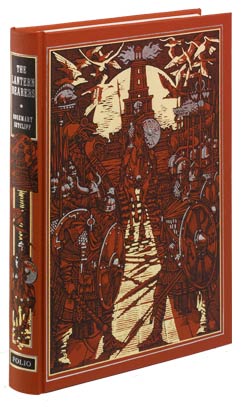
Folio Society edition of Rosemary SutcliffHere we go, or went, again – a publisher or newspaper spelling Rosemary Sutcliff’s name correctly: it is not, as avid readers of Rosemary Sutcliff (sic) and keen followers of this blog know well, Rosemary Sutcliffe with an E! The culprit this time? It was the Folio Society, which publishes beautiful editions of several of her books (The Lantern Bearers, for example, pictured above) . On their biography page – correctly headed Rosemary Sutcliff – they managed six Sutcliffes in as many paragraphs (and one Sutcliff); but they have now corrected that. How could they get it so wrong?

But do not let my grumbling put you off: if you can afford them, these editions are wonderful gifts, and a joy to read and own.

The Lantern Bearers, The Eagle of the Ninth, The Silver Branch by Rosemary Sutcliff, Folio Editions

More examples of writing Rosemary Sutcliff as Sutcliffe

Tudor Times described by Rosemary Sutcliff in The Armourer’s House (1951)

Cover of Red Fox edition of Rosemary Sutcliff's Tudor children's historical fiction The Armourer's HouseA history GCSE-teaching site ( johndclare.net)  quotes this extract from Rosemary Sutcliff’s The Armourer’s House (unfortunately mis-stating the book’s title as  ‘The Armourer’s Apprentice’ at one point!). He invites learners to compare the ‘picture’  she paints of Tudor times with that suggested by a woodcut that “showed the things that made the Tudor street an unhealthy place in which to live”.

He says of The Armourer’s House that it is  “a children’s book written in the 1980s about Tamsyn, a lttle girl visiting Tudor London.” Actually, Tamsyn was not just ‘visiting’: Following the death of her grandmother, Tamsyn is sent to grow up with her uncle, a famous armourer, and his family in London, in the time of King Henry the Eight (VIIIth), in the period when he was married to one of his many wives – Anne Boleyn. Tamsyn’s dream of setting sail with her seafaring uncle was dashed.  For she would have much preferred to stay in Devon, watching the uncle’s ships. She was homesick until she discovered that a cousin, Piers, shared her feeling for the sea, and they became close friends.

Mr Clare could not be much more wrong about the date (he cites as 1980s), either. The Armourer’s House was one of the first books written by Rosemary Sutcliff, published first in 1951! Anyway, as Rosemary puts it:

In those days cities were not at all like they are now.  They were small and compact and cosy.  The houses were cuddled close together inside their city walls, with the towers of their cathedrals standing over them to keep them safe from harm.  London was like that.  As you came towards it, up the Strand from Westminster or over the meadows from Hampstead, you could see the towers and spires and steep roofs of the City rising above its protecting walls as gay as flowers in a flower-pot; and when you had passed through the gates (there were eight fine gates to London Town), the streets were narrow and crooked and very dirty, but bright with swinging shop-signs and hurrying crowds.  And the shops under the brilliant signs were as gay as fairground booths, with broidered gloves and silver hand-mirrors, jewels to hang in ladies’ ears, baskets of plaited rushes, coifs of bone lace, wooden cradles hung with little golden bells for wealthy babies.  Other shops sold the rare and lovely things from overseas that were still new to the English people – Venetian goblets as fine as soap bubbles, pale eastern silks, strange spices for rich men’s tables, and musk in little flasks for people to make themselves smell nice.  But if you wanted ordinary things, such as food or preserving pans, you went to Cheapside or some other market; and if you wanted herbs you went to the herb market, which was really one of the loveliest places in London, because most flowers and green things counted as herbs in those days.

The street of the Dolphin House was one of the nicest streets in London.  It was a very busy street, full of a great coming and going that went on all the daylight hours, so that there was always something to watch from the windows … Brown-clad monks, and church carvers and candle-makers, merchants and yet more merchants, and jewellers and silversmiths, and sailors everywhere – more sailors every day, it seemed to Tamsyn.  All these came and went along the street, and sometimes a great lord would ride by on a tall horse, or a lady with winged sleeves of golden gauze and servants running ahead to clear the way lather.  Strolling players often passed that way, too, on their way from Ludgate to the Fountain Tavern, where they acted their plays; and Morris Dancers, or a performing bear led by a little boy, or a man with a cadge of hawks for sale …

Oh, it was a very exciting street, and as the weeks went by, Tamsyn began to like it very much indeed.

The Woodcut:
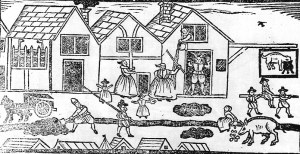
Tudor life woodcut of street scene

Source:  Key Stage 3 at www.johndclare.net