Writer E. M. Epps gives thumbs up for A Circlet of Oak Leaves by Rosemary Sutcliff.

A Circlet of Oak Leaves:  cover of book by Rosemary SutcliffA self-described “bookseller, reader, science fiction; fantasy writer, photographer, and gluten-free cook”, who signs her “name E. M. Epps”, gave a “thumbs up” for A Circlet of Oak Leaves by Rosemary Sutcliff at her blog “This space intentionally left blank”. She wrote”

A little novella taking place in Roman Britain. A slight book, but beautifully written as I would expect from Sutcliff.

“So he took them on, through a vicious squall of slingstones. Where the ground grew too steep to ride they dropped from the horses and ran on, crouching with heads down behind their light bronze-rimmed bucklers. By the time they reached the spur, hearts and lungs bursting within them, he had no idea how many or how few were still behind him; he had no chance to look round. He did not even know that many of the horses, lightened of their riders ‘ weight, had come scrambling after them, bringing their own weapons, the stallions’ weapons of teeth and trampling hooves, into the fight. He only knew that the time came when there were no more Painted Men left alive on the spur, and that the terrible boulder [perched above them], swaying as it seemed to every breath, was still there.”

Source: This Space Intentionally Left Blank – writer E. M. Epps’s blog.
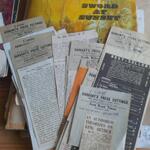
Quotes from Rosemary Sutcliff’s Arthurian novel Sword at Sunset |Chosen by ~*LunaSea*~ blog

Press cuttings about Historical novel Sword at Sunset by Rosemary SutcliffQuotes to ponder from Rosemary Sutcliff’s Arthurian novel Sword at Sunset in the eyes of a recent reader:

“The taste of vomit was in my very soul, and a shadow lay between me and the sun”

“To go into battle drunk is a glory worth experiencing, but it does not make for clear and detailed memory”

“In war and in the wilderness one easily loses count of time”

“A wonderful thing is habit”

And the author of the blog, a lunatic reader with self-ascribed ‘book lust’,  especially liked :

“Silence took us by the throat”

from:  ~*LunaSea*~ | a life reading words.

More about Sword at Sunset by Rosemary Sutcliff on this blog

Did The Eagle of the Ninth historical novelist Rosemary Sutcliff want to be a romantic novelist?

Rosemary Sutcliff‘s life and work in children’s, young adult, and adult literature, including The Eagle of the Ninth, was commented upon in 2003 by one of her editors on a website which I cannot now find (and I posted this first in April last year, 2010). She did have a “mystical communion with the past”, an “uncanny sense of place” and a rude sense of humour. But she certainly did not aspire to being a romantic novelist with books “full of sex”. Nor did she feel she had been “let down” by being “crippled by Stills disease”. And her best work was not only in the first half of her career; she had award-winning books up to the end of her life.

She wrote fine books after the 1950s and 1960s, for example the award-winning Song for a Dark Queen in the 1970s, The Shining Company in the 1980s (which won The USA’s Phoenix Award in 2010), and even her last manuscript Sword Song which was published after her death in the 1990s.Read More »

Children’s writer Rosemary Sutcliff said writing for adults only a small gear-change

Prompted by The Guardian who recently did an item where ” authors reveal the secrets of their craft … (in) …  interviews with some of our most celebrated writers recorded for the British Library, I am reminded , again, that Rosemary often said that she wrote for children aged 8 to 88, and that she once spoke  in an interview about the difference between writing for children and for adults:

The themes of my children’s books are mostly quite adult, and in fact the difference between writing for children and for adults is, to me at any rate, only a quite small gear change.

The Shining Company award-winning novel by Rosemary Sutcliff

The Shining Company by Rosemary SutcliffSee now, for a good blade, one that will not betray the man in battle, rods of hard and soft iron must be heated and braided together. Then is the blade folded over and hammered flat again, and maybe yet again, many times for the finest blades … So the hard and soft iron are mingled without blending, before the blade is hammered up to its finished form and tempered, and ground to an edge that shall draw blood from the wind. So comes the pattern, like oil and water that mingle but do not mix. Yet it is the strength of the blade, for without the hard iron the blade would bend in battle, and without the soft iron it would break.
Source: Goodreads quotations from Rosemary Sutcliff