For award-winning, internationally-acclaimed author Rosemary Sutcliff (1920-92). By Anthony Lawton: godson, cousin & literary executor. Rosemary Sutcliff wrote historical fiction, children's literature and books, films, TV & radio, including The Eagle of the Ninth, Sword at Sunset, Song for a Dark Queen, The Mark of the Horse Lord, The Silver Branch, The Lantern Bearers, Dawn Wind, Blue Remembered Hills.
Rosemary Sutcliff’s imaginings – and those of the the film-making experts – for The Eagle of the Ninth are translated into costumes for the film The Eagle. Those involved speak about it here.
In Digging Up the Past (‘a news and resource centre for Biblical archaeology’) Kendall K. Down posted something written in 2009 about the disappearance of the Ninth Legion, possibly in Scotland, referring to Rosemary Sutcliff’s book The Eagle of the Ninth and the coming film (now called The Eagle and out in 2011). He reviewed the ‘evidence’ to date as he interpreted it. He concluded:
Good reasons can be found for rejecting the tale of a Scottish defeat, but no good reasons can be found for accepting any alternative proposal, so I suppose the best conclusion is the one that earlier historians proposed: the disappearance of the Ninth Legion is a mystery.
That is unless Rosemary Sutcliff’s informed but creative leaps of the imagination in The Eagle of the Ninth satisfy you …
Intriguingly he writes of latter-day research in Scotland:
A new survey of Scotland has found evidence that the story of the Romans north of Hadrian’s Wall is far more complicated than historians have hitherto thought. Ground surveys have previously found 225 Roman military camps from the Borders to Aberdeenshire. (This compares with 150 in England and Wales.) Now a new study using remote sensing technology is set to increase that number, while the Deers Den excavations at Kintore in Aberdeenshire show the extent of the Roman commitment to conquering Scotland: 44 bread ovens have been uncovered!
Classic children’s historical novelist Rosemary Sutcliff was inspired to write many books set in Roman Britain, including The Eagle of the Ninth, now a major motion picture (or film in UK English!).
I found this great old map of Roman Britain on Wikipedia, which includes the names of British tribes, Roman towns and the Routes of Caesar’s expeditions from 55 to 54 BC.
I have just finished reading Rosemary Sutcliff’s classic children’s (and adult) historical novel The Eagle of the Ninth and absolutely loved it. One of the things that stood out to me in the book were the early religions that were worshipped in Britain in 117 A.D.
It seems there were many different gods worshipped by tribes and Romans. The lead character Marcus, a Roman centurion, worships the god Mythras of the Mythraic religion. Esca, his companion and a native Briton, prays to a god named Lugh. Both religions are now regarded as forms of paganism and both of these gods are described by Rosemary Sucliff as sun gods.
I’ve started to research both of these gods and their religions and would be interested in any information available.
I have discovered so far that Lugh is an ancient deity from Irish Celtic Paganism. He is the god of the harvest and is depicted as a great warrior from the distant past. He is also known as Lamfhada or ‘of the long arm’ in Gaelic because of his magic spear and sling. He is also known as Lugas in Pan celtic mythology in other parts of europe and as Lleu Llaw Gyffes in Welsh. It is interesting that Rosemary Sutcliff chose Lugh as the deity worshiped by Esca, a Briton. It suggests that she believed celtic paganism was practiced throughout Britain and travelled from Ireland, which was known as Hibernia in Roman times.
Votive inscription to Lugus. Lugo, Galicia
Marcus the centurion’s god is Mythras, of the Mythraic histories. I visited an ancient Mythraic temple underneath the church of St Clamente in Rome, back in September.
Mythraic temples were always secret places and usually underground, beneath other buildings. Mythras was commonly worshipped by the Roman Military in the first to the fourth centuries, so Rosemary Sutcliff was absolutely accurate in choosing Mythras as the deity worshipped by Marcus. Not much is known about the Mythraic mysteries as it was a secret religion, however it is believed that it was first formed in Rome.
Mithras born from the rock (petra genetrix), Marble, 180-192 CE. From the area of S. Stefano Rotondo, Rome.
I woud love to know more on both of these ancient religions and their possible similarities, so please post any links and information you have on the subject.
Here are some links to information on the Mythraic Mysteries and of the celtic god lugh.
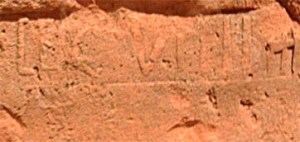
A while back I posted about how VIIII not IX was the ancient way of writing for The Ninth Legion. A recent comment by Duncan Campbell (thank you!) on that post reveals the limits of my knowledge. He writes that to say, as I did, that “The use of IX is a modernism, the Ancient use of the number would have been VIIII” is “not strictly true”.
Fifteen different versions of the Ninth Legion’s tile stamp are known — whenever Roman military units manufactured tiles, they tended to stamp them. Those found in the vicinity of York (Eburacum) were stamped LEG IX HISP, but those found in the vicinity of Carlisle (where there was a major tilery) were stamped LEG VIIII or LEG VIIII H.
The latter version also turns up in the vicinity of Nijmegen in the Netherlands, and is one of the main reasons for our current thinking that the legion was transferred from Britain to the Continent, either by Trajan or by Hadrian.
A tile found in a pottery near Carlisle bears the stamp of the Ninth Legion - LEG VIIII H (for Hispana).


 ROSEMARY SUTCLIFF (1920-92)