Rosemary Sutcliff could not read until she was ten or eleven years old

Rosemary Sutcliff could not read until she was ten or eleven years old. Certainly aged nine she saw no point!

My mother in her own splendidly unorthodox fashion, taught me at home, chiefly by reading to me. King Arthur and Robin Hood, myths and legends of the classical world, The Wind in the Willows, The Tailor of Gloucester, Treasure Island, Nicholas Nickleby, Kim, Puck of Pook’s Hill, and Little Women, all at more or less the same time. The result was that at the age of nine I was happily at home with a rich and somewhat indigestible stir about of literature, but was not yet able to read to myself. Why, after all, read to yourself when you can get somebody else to read to you?

Historical novelist Rosemary Sutcliff's mother Nessie Lawton 

Source: Donald R. Gallo (1990) Speaking for Ourselves: Autobiographical Sketches by Notable Authors of Books for Young Adults. National Council of Teachers of English.
Rosemary Sutcliff on writing Sword at Sunset in the first person

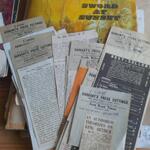
Press cuttings about Historical novel Sword at Sunset by Rosemary Sutcliff

Rosemary Sutcliff once said about writing her Arthurian novel  Sword at Sunset – a bestseller in 1963:

… after I had finished the story I had great difficulty getting back into a woman’s skin, because I had been living as a man for eighteen months, thinking as a man, making love as a man, always looking from a man’s viewpoint. I am always deeply involved in my books. For me the book doesn’t work if I am not. But I have never been as deeply involved as that before or since.

When I started writing Sword at Sunset I made at least three false starts, but I couldn’t think what was the matter. I knew exactly what the story was that I wanted to tell, but it wouldn’t come. Then suddenly the penny dropped: it had to be first-person singular. I had never done first-person singular before, but the moment I started doing it that way it came, like a bird. But I had problems with it: first-person singular is very different from third-person writing, and I had no experience of it at all. But it was the only way it could be written.

I will choose a good story over absolute historical accuracy | Rosemary Sutcliff on writing historical fiction

Since I am a writer, not an historian, I will sacrifice historical accuracy. I really very seldom have to do it, and then it is only a matter of perhaps reversing the order of two events, or something like that. But if it does come to the crunch, I will choose a good story over absolute historical accuracy.

Source: Interview with Rosemary Sutcliff  by Raymond H Thompson (here, on this blog)


Storytelling by Rosemary Sutcliff was ‘A dialogue of the imagination’ with ‘one of the minstrel kind’

Margaret Meek, who wrote a significant monograph about Rosemary Sutcliff in the 1960s  early in RS’s career, wrote about her again in 1990 on the publication of The Shining Company:

The sharing of storytelling that writers do with readers is the dialogue of imagination. Rosemary Sutcliff lives, grows and acts and suffers in her stories. The worlds created in her imagination have had to stand in for the world of much everyday actuality. From her therefore we can learn what the imagination does, and how it allows us all to explore what’s possible, the realm of virtual experience. In Rosemary Sutcliff‘s world, heroes, heroines and readers alike walk a head taller than usual, as heroic warriors, to confront, like Drem in Warrior Scarlet, fearsome events as rites of passage and thus discover what is worth striving for.

Readers have to expect to be spellbound in the tradition of storytelling that’s much older than reading and writing, when before the days of written records bards and minstrels were entrusted with the memory of a tribe. Rosemary Sutcliff is in this tradition; she says of herself that she’s `of the minstrel kind’. This in itself sets her apart from some of the more, apparently, throwaway casualness of some contemporary writing. In these days, when we’ve learned to look closely at the constructedness of narratives, she will still say that she knows when a story is `in’ her and `waiting to be told’.

Books for Keeps logo

Source: Issue 64 of Books for Keeps

Rosemary Sutcliff’s thank-you address to the American Children’s Literature Association in Arbor, Michigan, 19th May 1985 | For the Phoenix Award for The Mark of the Horse Lord

Rosemary Sutcliff sent an address to the Children’s Literature Association in Arbor, Michigan, 19th May 1985 when she received the Phoenix Award for The Mark of the Horse Lord. This is an excerpt.

The Mark of the Horse-Lord  is one of my best-beloved books, amongst my own, and has remained so warmly living in my mind, though I have never re-read it, that when I heard that it had won an award for a book published twenty years ago, my first thought was “How lovely!! But my second was, ‘But it can’t be anywhere near twenty years old; it’s one of my quite recent books; there must be some mistake!” And I made all speed to get it out of the bookcase and look at the publication date, to make sure. And having got it out, of course I started reading it again.

Re-reading a book of my own is for me (and I imagine for most authors) a faintly nerve-wracking process, Read More »