Before Rosemary Sutcliff became a published writer in the 1950s she was an artist. She made beautiful miniature paintings, and later a stunning nativity scene. I inherited this when she died in 1992.


Before Rosemary Sutcliff became a published writer in the 1950s she was an artist. She made beautiful miniature paintings, and later a stunning nativity scene. I inherited this when she died in 1992.
On exploring Google Book Search a while back, bloggers and Rosemary Sutcliff fans Sandra Garside-Neville and Sarah Cuthbertson posted that they had:
… found a Rosemary Sutcliff short story that was new to me. It’s called Flowering Dagger and is in a collection called ‘Within the Hollow Hills: an anthology of new Celtic writing’, edited by John Matthews, published 2000 by Steiner Books. A few sample pages can be found here. It was originally published in ‘The Real Thing’, edited by Peggy Woodford, Bodley Head, 1977. Other contributors include: Robin Williamson, R.J. Stewart, Caitlin Matthews, David Spangler, Peter Vansittart, Henry Treece and Margaret Elphinstone, plus others.
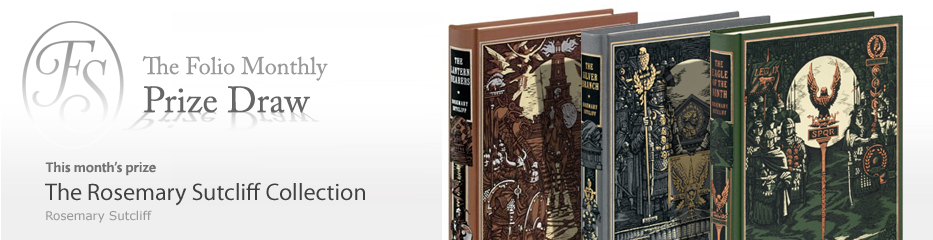
The Folio Society have made their beautiful Rosemary Sutcliff Collection their prize draw for Dec. Make a free entry. I have!
Interesting article in today’s UK Sunday Times newspaper, in the ‘culture’ section. Unfortunately for non subscribers or buyers of the paper, behind a pay-wall. Some key points and passages are:
… Few literary genres have a readership that is quite as gender-divided. Women do read male historical authors, even the ones who specialise in blood-spattered warrior adventures. Yet in a world where all the market research indicates that most men are inherently prejudiced against picking up a book written by a woman, it can be an uphill battle for a female author to reach a male readership. This is why so many women writing historical fiction publish under names that deliberately obscure their gender: Robyn Young, MC Scott, SJ Parris, AL Berridge
and, in the new year, MJ Carter have all taken this route.
… Manda Scott … saw a shift in her readership from an 80% female/20% male audience to a 50/50 one when she published her latest Rome espionage series as MC Scott …
… historical fiction appears to be in robust health. Sales are running at a three-year high, up 14% on 2012, which … is all the more exceptional when you consider that overall sales of novels are down 21%
… Without Mantel’s success, it would be hard to imagine the hoopla that recently marked the republication of some of Mary Renault’s work.
I think attention of editors and marketing departments was re-focused on what was inherently excellenty and widely-read work – like Rosemary Sutcliff’s!
… “When I started writing historical fiction, around the turn of the millennium, big literary names writing books that happened to be set in a historic period were absolutely adamant that they were not writing historical novels,” says (Manda) Scott, who, as well as being an author, is the founding chairwoman of the Historical Writers Association (HWA). “Today those same people are perfectly happy to be considered historical writers.”
… not many historic periods are considered sellable to Americans. This is why the Romans, Vikings, Crusaders, Plantagenets, Tudors and Victorians are mined for colourful historic context, while authors are discouraged from pitching series set in the 17th and 18th centuries.
… female authors have dominated 2013. Mantel holds the first and third spot, while Philippa Gregory — author of The White Queen, adapted for the BBC this summer — is responsible for 7 of the top 20 titles, 4 in the top 10. Cornwell is the only male author to make the top 5, or even the top 15.
… Another influence on the robustness of the genre is not a historic series at all, but a fantasy one … The phenomenal international success of George RR Martin’s novels has created an appetite for bloody dynastic sagas. Though they are fantasy, the books are rich in historical context: their author has always said that he was inspired by the Plantagenets.
Source: History Prejudice, Sunday Times, December 15th (behind paywall)
Rosemary Sutcliff did not read until she was about ten. Over at Facebook , Anne McFadgen – thank you Anne – has pointed out recently that it was “because her mother never read down to her that Rosemary Sutcliff made the conscious decision that she wouldn’t learn to read”. Anne quotes from Rosemary Sutcliff’s autobiography of her […]
 ROSEMARY SUTCLIFF (1920-92)